
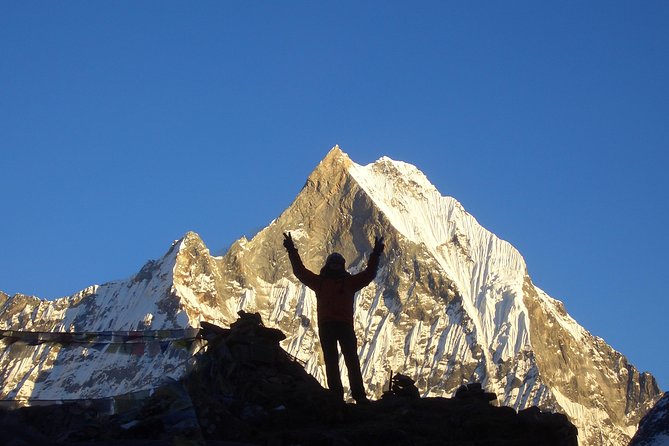
Reviewed · ANNAPURNA BASE CAMP TREKS
Annapurna Base Camp Trekking – 14 Days
Altitude moves in fast on this trek. You rise from Kathmandu’s city bustle into rhododendron and bamboo country, then reach Annapurna Base Camp at about 4130m, all with an itinerary built around acclimatization and straightforward tea house comfort. I especially like how the pacing is planned so you do not just rush upward and hope for the best.
The main consideration is altitude stress, particularly once you are working at higher elevations like Machhapuchre Base Camp (about 3700m). If weather shifts, you may also need to be flexible, because safety decisions can change the day-to-day plan.
In This Review
- Key highlights
- Kathmandu to Pokhara, then straight into trekking mode
- Nayapul to Ghorepani: stone stairs, forests, and a big first climb
- Tadapani and Chhomrung: building height without burning out
- Chhomrung to Dovan and up to Machhapuchre Base Camp
- Annapurna Base Camp at ~4130m: your main goal comes with real altitude
- Bamboo and Jhinu Danda: the descent that still demands attention
- The last hiking days, then the return to Kathmandu
- Why the acclimatization plan actually makes sense
- Tea house lodge trekking: comfortable enough to focus on walking
- Your guide and porter system, and why it matters more than you think
- Price and value: what $1,250 includes, and what you still pay on your own
- Should you book this 14-day Annapurna Base Camp trek?
- FAQ
- Where is the meeting point for this trek?
- How long is the Annapurna Base Camp trek?
- What is the highest elevation on the itinerary?
- Is this trip private?
- What permits and fees are included?
- What meals are included during the trek?
- What water setup do you use on the trek?
- When is the best time to do the trek?
- What costs should I plan for that are not included?
Key highlights
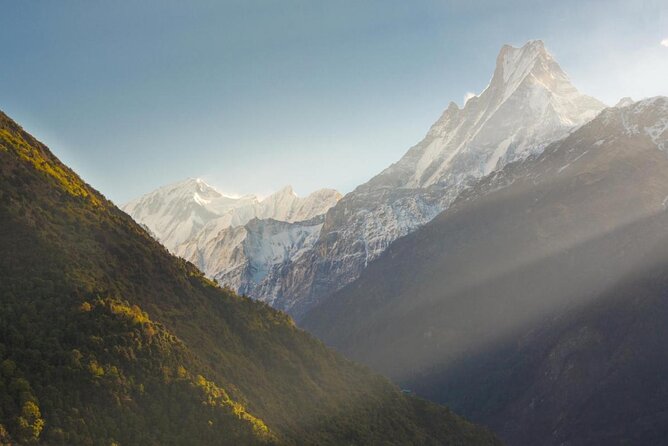
- Annapurna Base Camp at ~4130m with extra days designed to help your body adjust
- Tea house lodge trekking with full board meals during the trek and simple twin-share rooms
- English-speaking Sherpa guide plus a porter system (one porter for every two trekkers)
- Permits and Annapurna Conservation Fee handled in the package price (TIMS included)
- Fuel for the trail with snack energy supplies like Snickers, Mars, Bounty, plus fresh fruit
- Reliable water approach using Euro-guard filters and a target of at least 3 liters a day
Kathmandu to Pokhara, then straight into trekking mode
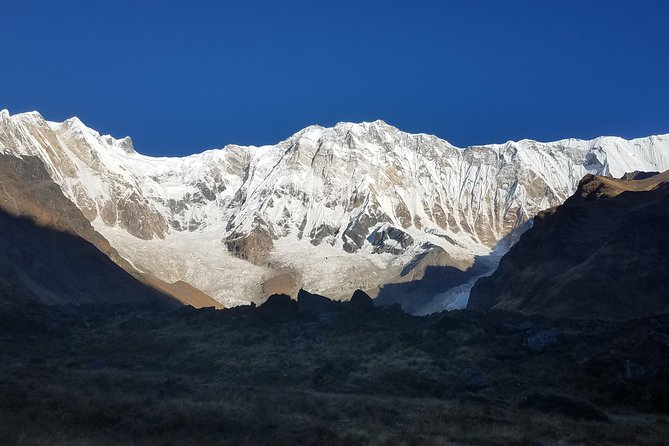
This trek does not start with a long hike. It starts with getting you set up in Kathmandu (meeting point is Thamel) and then moving you to Pokhara for a sensible ramp into mountain walking.
Day 1 is arrival in Kathmandu, where you will sleep two nights in a twin-share room on a bed and breakfast basis. The “pre-trek” base matters. You get one or two easier days to get organized, sort gear, and adjust to Nepal’s time and traffic before your legs meet the trail.
Day 2 is the drive to Pokhara, around 900m. You are traveling from city altitude into the foothills, and you will likely feel the difference right away when you step outside. This is also a good day to do the quiet prep work: double-check your water bottle and purification setup, and make sure you have layers you can handle through changing temperatures.
Day 3 brings the first real trekking day. You drive to Nayapul (about 1010m) and then hike to Hile (about 1400m) for roughly 3 hours. Expect a gentle start, but do not underestimate it. The first day sets your rhythm and tells you how your body reacts to walking while carrying a day pack.
More Treks in Kathmandu
- Everest Base Camp Trek – 14 Days
★ 5.0 · 1,499 reviews - Everest Base Camp Trek
★ 5.0 · 842 reviews - Everest Base Camp Trekking
★ 5.0 · 485 reviews
Nayapul to Ghorepani: stone stairs, forests, and a big first climb
Day 4 is the first major jump, trekking from Hile toward Ghorepani (about 2855m) with a time window of 6-7 hours. This is where the “welcome to the Annapurna region” feeling really kicks in. You gain elevation fast, and the trail climbs through the kinds of areas described for this route, including rhododendron and bamboo zones.
What I like here is the mix. The trek is not just one long ascent. It carves its way upward through narrow gorges like Modi Kola on the way to higher terrain, and you start seeing why this area is so rewarding for people who like variety. You are walking more than simply grinding altitude.
Your practical move on Day 4: keep your pace slow and your stops frequent. The trek package explicitly aims to reduce altitude risk by using breaks and a steady rhythm. You are not trying to “finish strong” today. You are trying to finish comfortable, with your breathing under control.
Tadapani and Chhomrung: building height without burning out
Day 5 is a trek from Ghorepani to Tadapani (about 2610m), around 5 hours. This is still high country, but it gives you a chance to settle into how your body prefers to work at elevation. You are likely to feel the air thinning more than you did on Day 3, so a steady pace matters more than speed.
Day 6 moves you to Chhomrung (about 2040m) in roughly 4 hours. This part of the trek shows why the route is interesting: you gain, you adjust, and you change elevation enough to keep you engaged. It also helps your legs after a tougher day, even if the overall trip still remains demanding.
A drawback to watch: when you feel good mid-trek, it is tempting to speed up. Do not. Even on descent, altitude recovery is not automatic. Your body still needs time to adapt, and the itinerary is built around that idea.
Chhomrung to Dovan and up to Machhapuchre Base Camp
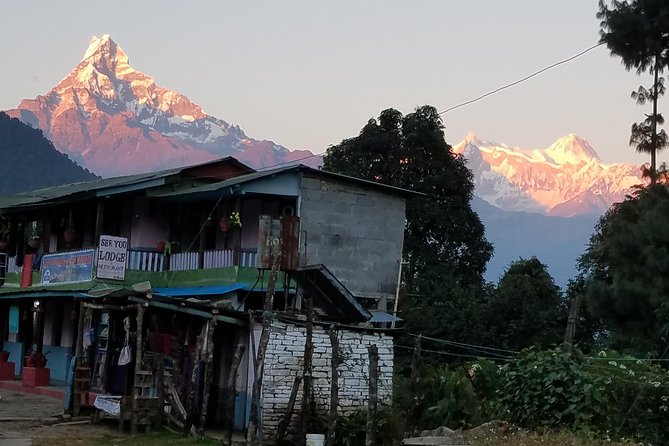
Day 7 heads from Chhomrung to Dovan (about 2550m) for about 4-5 hours. This day continues the climb into higher zones where the terrain starts feeling more austere. You are getting closer to the “high and glaciated wilderness” vibe described for this area.
Day 8 is a standout day: trekking to Machhapuchre Base Camp (about 3700m) in roughly 4-5 hours. Machhapuchre Base Camp is one of those places where you will feel the altitude shift, even if you keep a slow pace. It is also a day that tests your mental stamina, because the climb is real and the air is thinner.
The best way to handle Day 8 is boring on purpose: walk slowly, stop often, and do not try to make up time. Your guide and porter team are there for more than directions. They also help with pacing and comfort so you do not turn elevation into panic.
More Annapurna Base Camp treks:
- Annapurna base camp trek 5 Days
★ 5.0 · 252 reviews - 14-Day Private Annapurna Base Camp Trek
★ 5.0 · 180 reviews - Annapurna Base Camp Trekking
★ 5.0 · 116 reviews - Annapurna Base Camp Trek
★ 5.0 · 111 reviews
Annapurna Base Camp at ~4130m: your main goal comes with real altitude
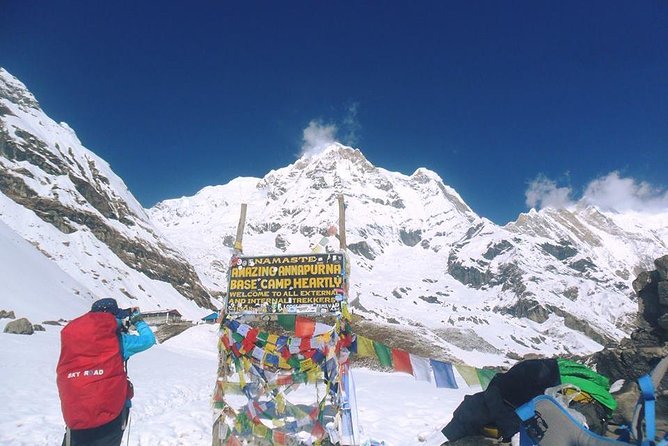
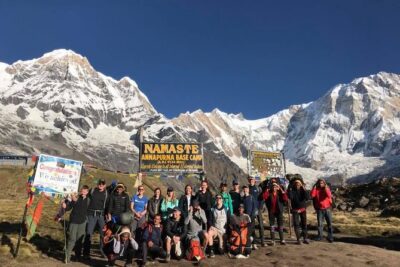
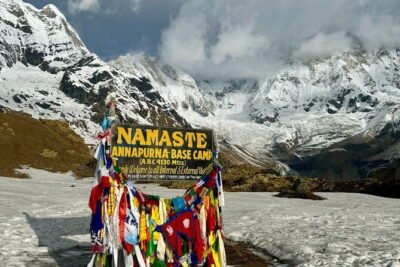
Day 9 is the big one, trekking to Annapurna Base Camp (about 4130m) in roughly 2-3 hours. On paper, it looks shorter. In real life, shorter can still mean hard, because you are arriving at the trek’s high point after days of climbing.
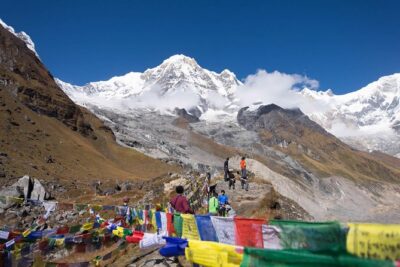
This is the moment where the trek’s promise makes sense. Annapurna Base Camp sits in a high glacial basin used by expeditions aiming at massive peaks in the region, including Annapurna I from the south face. Even without fancy explanation, the setting does the teaching. You get surrounded by an area associated with major Himalayan peaks, and you really understand why climbers care about this exact geography.
Practical tip for your “base camp day” mood: save your effort for the last part. Do not sprint the final approach just because it is shorter on the schedule. Your body is still adjusting at around the 4000m mark, and the trek is planned to keep that risk lower.
Bamboo and Jhinu Danda: the descent that still demands attention
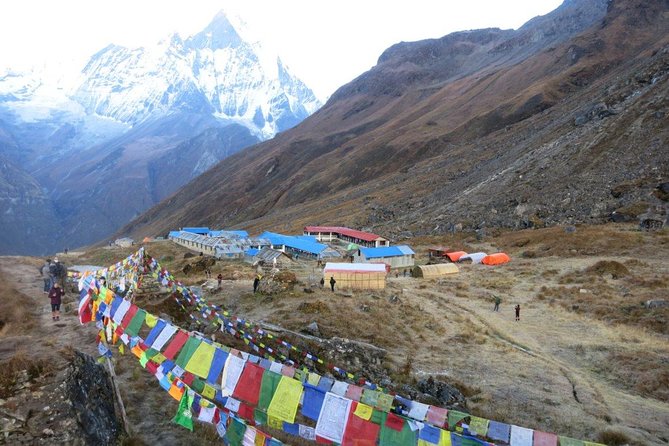
Day 10 goes from Annapurna Base Camp down to Bamboo (about 2340m), around 4-5 hours. Descent helps, but it is not a free ride. Your knees and feet still have to absorb time on steep terrain, and altitude effects can linger even as the trail drops.
Day 11 continues to Jhinu Danda (about 1780m) for about 5 hours. This is where you start feeling more “normal” physically, which can be a relief after the high-elevation days. Still, your best strategy is patience. Slow descents are often safer than fast ones.
The itinerary here is another good point in favor of this trek. You are not cutting the top days too close together. The plan gives you time at higher elevation, then gradually lowers you back down in stages.
The last hiking days, then the return to Kathmandu
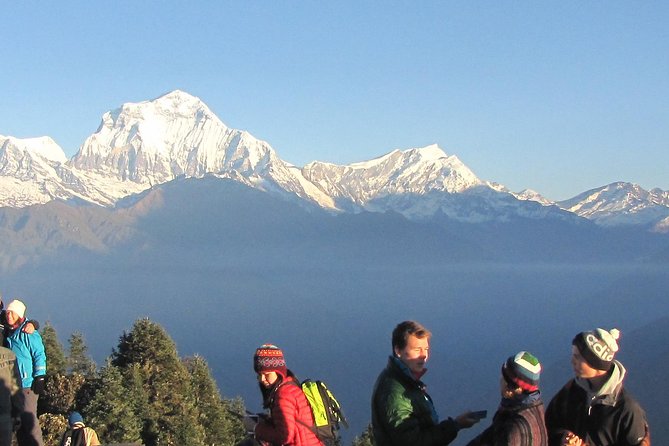
Day 12 is the trek from Jhinu Danda to Nayapul-Pokhara area (about 900m) for roughly 5-6 hours. This is your transition day back toward lower altitude and easier walking conditions. The trail is still work, but it is often easier than the 2500m-plus segments.
Day 13 is the drive back to Kathmandu, around 1345m. You trade boots for vehicles for a change of pace, and that matters after days of walking. It is also a good time to stretch, rehydrate, and do light recovery.
Day 14 is your departure from Kathmandu. You will start and end back at Thamel, so the whole trip stays anchored to an easy-to-reach meeting point rather than scattered pickups.
Why the acclimatization plan actually makes sense
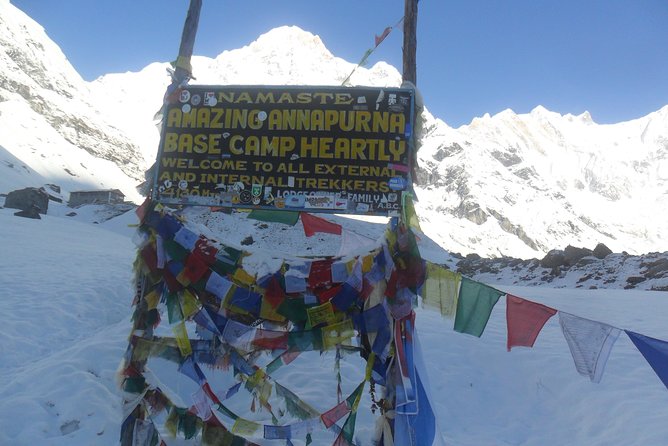
This itinerary is planned around altitude reality, not wishful thinking. Annapurna Base Camp sits a little over 4000m, and the higher you go, the more your body needs time to adjust.
I like how the trek includes several days where you gain elevation, then you have time to settle before going higher. The slow pace and plenty of breaks are explicitly part of the plan. That is not just a style choice. It is your built-in risk management.
There is also the water guidance, which helps you acclimatize better in practice. The trek recommends you drink at least 3 liters of water each day, and in the Annapurna region you can use Euro-guard filters so you can refill easily with your own bottle. In high-altitude trekking, hydration is often the difference between feeling steady and feeling wiped out.
Safety is also treated as a real priority. If conditions change, the itinerary is not set in stone. You are asked to accept decisions and advice from the guide if changes or cancellations are needed due to safety concerns. That flexibility can be the difference between pushing too hard and getting home with a good story.
Tea house lodge trekking: comfortable enough to focus on walking
This is a classic tea house / lodge trek, and that shapes what you experience each evening. During the trek, accommodation is in local lodges with full board meals and twin-share rooms for 9 nights. In general terms, rooms are simple and usually set up with two narrow beds.
I like this approach because it keeps you connected to local life without requiring you to carry a tent setup. The lodges are described as clean and comfortable, and they give you a chance to meet Nepalese families running the places you sleep. When your lodging is handled, you can focus on walking, eating, and resting.
In Kathmandu and Pokhara, you get two nights each in Hotel Holy Himalaya with bed and breakfast. That matters because you get real showers and normal routines before you switch back to mountain living.
One more practical bonus: the trek includes energy supplies such as Snickers, Mars, Bounty, and fresh fruits on the trail. On long days, that small predictable calorie boost can help you keep a steady pace instead of dragging when hunger hits.
Your guide and porter system, and why it matters more than you think
You will trek with an English speaking experienced Sherpa guide who is government trained and licensed. On past trips, guides named Ngima and Dawa show up in the story, and people also mention team members like Mingma, Nima, Tashi, and Pasang. Since guides can vary by departure, treat these names as examples of the kind of support you may receive, not a guarantee.
The porter plan is one porter for every two trekkers. That is a big deal because it means you can travel with a smaller day pack. Less weight helps you walk longer and makes acclimatization easier, since your body is not fighting both altitude and heavy loads.
Also, the package includes a first aid medicine kit. That does not replace good judgment, but it is part of how the operator reduces avoidable issues in remote terrain.
Price and value: what $1,250 includes, and what you still pay on your own
At $1,250 per person for 14 days, the value comes from what is bundled. Your price includes:
- Air-conditioned vehicle transport
- Two nights in Kathmandu and two nights in Pokhara, twin-share rooms on bed and breakfast
- 9 nights in local lodges on the trek, with full board meals
- Guide and porter support, plus porter staffing costs
- Trek staff costs like salary, insurance, equipment, food, and accommodation
- Energy snacks and fresh fruits on the trail
- First aid kit
- Annapurna Conservation Fee, TIMS permits, and required permits
- Ground transfers Kathmandu to Pokhara-Phedi and Nayapul to Pokhara, then back to Kathmandu
What is not included shapes your real budget. Your Nepal entry visa fee and your personal travel insurance are on you. Lunch and dinner in cities are not included, and the guidance is to allow about $10 to $14 per meal in tourist restaurants. Beverages are also extra, and tipping for guide, porters, and driver is customary.
There is also a practical spending buffer for extras on the trek. Even if your core meals are covered, you may want chocolate bars, soft drinks, mineral water, or beer, and costs tend to rise the farther you get from the trailhead. Plan around the given estimate of about $10 to $15 per day for additional items.
In short, the cost is not just for walking days. You are paying for permits, transportation, lodging logistics, and the human layer that helps you stay safe at altitude.
Should you book this 14-day Annapurna Base Camp trek?
Book this trek if you want a structured Annapurna Base Camp experience with tea house comfort, a licensed English speaking guide, and a pace designed for acclimatization. If you are a moderate fitness hiker and you want your days planned from Kathmandu to Pokhara and back, this format is a good fit.
I would think twice if you are someone who hates altitude risk planning or you cannot be flexible about weather. The itinerary is designed for good days, but it also asks you to accept route changes if conditions become unsafe. Also, at this price point, make sure you are comfortable covering the remaining items like visa, personal insurance, beverages, and customary tips.
Finally, pick your season. The best trekking windows are spring (February to late April) and autumn (late September to late November). Winter trekking is also possible for parts of this region, including Ghorepani and Annapurna Base Camp itself, but your day-to-day comfort will depend heavily on weather.
FAQ
Where is the meeting point for this trek?
The start and end are at the meeting point in Thamel, Kathmandu 44600, Nepal. The activity ends back at the meeting point.
How long is the Annapurna Base Camp trek?
The trekking experience runs for about 14 days.
What is the highest elevation on the itinerary?
Annapurna Base Camp is at about 4130m. Machhapuchre Base Camp is about 3700m.
Is this trip private?
Yes. It is listed as a private tour or activity, and only your group will participate.
What permits and fees are included?
The package includes the Annapurna Conservation Fee, TIMS permits, and all required permits or official documentation.
What meals are included during the trek?
Accommodation during the trek is in local lodges with full board meals for 9 nights. Lunch and dinner in cities are not included.
What water setup do you use on the trek?
You are advised to drink at least 3 liters of water each day. In the Annapurna region you can use Euro-guard filters, and you just need your own water bottle to refill.
When is the best time to do the trek?
The best seasons are spring (February to late April) and autumn (late September to late November). Winter trekking is also possible for parts of the region, including Annapurna Base Camp.
What costs should I plan for that are not included?
Not included are your personal travel insurance, Nepal entry visa fee, lunch and dinner in cities (about $10 to $14 per meal in tourist restaurants), beverages, and tips for the guide, porters, and driver.
Latest additions near Kathmandu
- White Water River Rafting – 1 Day★ 4.3 · 3 reviews
- Traditional Momo Making Class★ 5.0 · 10 reviews
- Kathmandu to Pokhara Premium sofa bus ticket★ 4.0 · 17 reviews
- Ghorepani Poon Hill Trek★ 5.0 · 16 reviews
- Amazing 1 Day Trekking Experience in Kathmandu Nepal★ 5.0 · 24 reviews
- Ghorepani Poonhill Trek★ 5.0 · 5 reviews
- Walking tour of real Kathmandu through back streets.★ 5.0 · 3 reviews
- Wildlife Adventure in Chitwan Nepal★ 4.0 · 4 reviews
Annapurna Base Camp Treks, compared.
Kathmandu to Annapurna Base Camp (ABC) 5-Day Trek
Read our review →
Browse the lists this tour appears in