
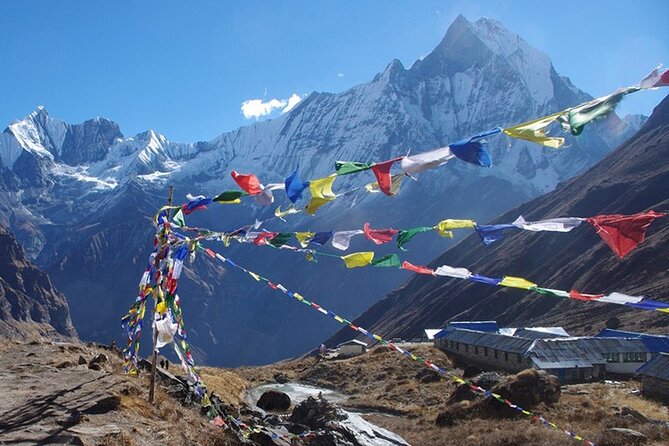
Reviewed · ANNAPURNA BASE CAMP TREKS
Annapurna Base Camp Trek -13 Days
Annapurna Base Camp hits fast, then stays with you. This 13-day private trek is interesting because it pairs tea house comfort on the trail with two 3-star hotel nights in Kathmandu and Pokhara, plus guides and permits handled for you. I especially like the way they set you up with all the essentials up front, including TIMS and ACAP paperwork and full trek meals, and I love that the pace stays more personal thanks to a private group plus a porter support ratio (1 porter for 2 clients). A main consideration is physical readiness, because you’ll face long days of ascent and descent, plus big stair sections and altitude climbing even before you get to Base Camp.
If you want the mountains without turning your trip into a logistics project, this package is built for that. You’ll start with a smooth arrival transfer to Kathmandu, then do a Pokhara valley break before your first trekking climbs, including an early Poon Hill sunrise day. The one tradeoff is that “easy” here still means hiking, and tea house stays are basic by design.
In This Review
- Key things I’d zoom in on before you book
- Entering The Base Camp Route With Kathmandu And Pokhara Included
- Day 1 to 2: Tribhuvan arrival, Kathmandu sleep, then Pokhara valley views
- Day 3 to 4: Nayapul to Tirkhedhunga, then Ulleri, villages, and Machhapuchhare views
- Day 5: The Poon Hill sunrise run and why the early wakeup earns its keep
- Day 6 to 7: Ullery onward toward Chhomrong, forests, and a very practical Chhomrong rest day
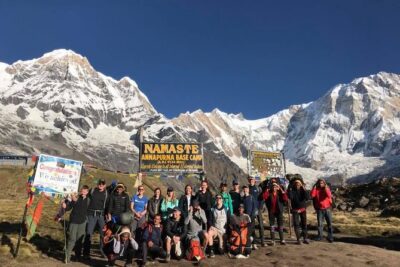
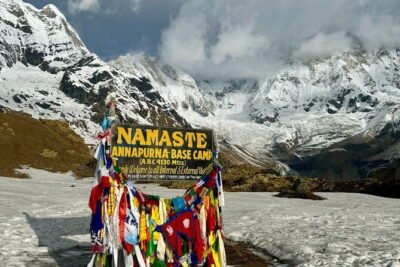
- Day 8 to 9: Alpine views, the approach to 4170m, and reaching Annapurna Base Camp
- Day 10: From Sinuwa to Chhomrong Khola, stone steps, and a hot spring reset
- Day 11 to 12: Waterfalls, Birethanti, the river corridor, then cable car country and Kathmandu gateway
- Day 13: Airport transfer timing and a clean landing back in regular life
- Price, value, and what the $1,200 actually buys you
- The guide and porter factor, safety, and why it affects your actual experience
- Who this Annapurna Base Camp trek suits best
- Should you book this 13-day Annapurna Base Camp trek?
Key things I’d zoom in on before you book
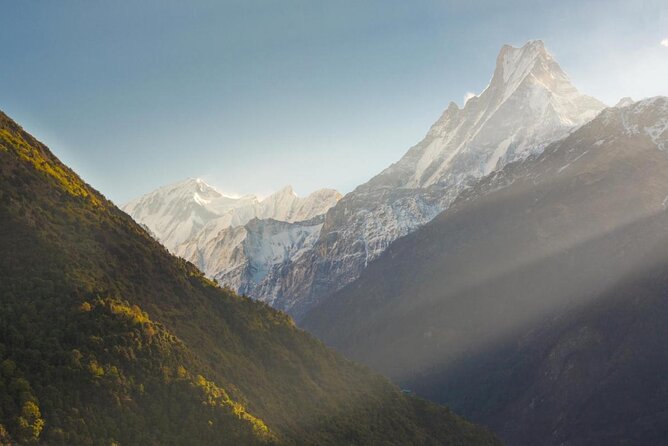
- Private trek feel with an experienced guide and porter support (1 porter for 2 clients)
- Permits included (TIMS and ACAP), so you do not scramble on paperwork
- Meals and tea house lodges included during the trek, which simplifies daily decisions
- Pokhara included with a Fewa Lake evening walk, so you get scenery downtime before hiking
- Base Camp-focused pacing with day-by-day progression toward 4170m Annapurna Base Camp
Entering The Base Camp Route With Kathmandu And Pokhara Included
The best part of this kind of packaged Annapurna trek is not the sticker price, it’s the reduction in friction. On paper, you are doing a challenging mountain route, but in practice you are not worrying about hotel bookings, permit steps, or day-to-day meal planning on the trail. You get pickup on arrival, private land transfers, and lodge arrangements that keep your head in the game.
You also get a rare luxury for treks like this: time in two cities. Two nights in Kathmandu (3-star hotels with breakfast) let you recover from travel and get oriented. Then you transfer to Pokhara for two more nights in 3-star hotels with breakfast. Pokhara matters because it offers the valley views of Annapurna and Dhaulagiri ranges, and it gives you that pre-trek mental reset. One evening walk around Fewa Lake is a simple touch, but it’s exactly the kind of low-effort break that helps your trekking legs later.
The package also includes some extras you might not expect at this price point. You get a trekkers’ information management system (TIMS) and ACAP permit, you receive company t-shirts, and there’s mention of medical supplies (a first aid kit available) plus arrangement of travel rescue. Those items matter on a trek like ABC, where weather and trail flow can change your day-to-day plan.
More Treks in Kathmandu
- Everest Base Camp Trek – 14 Days
★ 5.0 · 1,499 reviews - Everest Base Camp Trek
★ 5.0 · 842 reviews - Everest Base Camp Trekking
★ 5.0 · 485 reviews
Day 1 to 2: Tribhuvan arrival, Kathmandu sleep, then Pokhara valley views
Your start is smooth and direct: you arrive at Tribhuvan International Airport, and a company representative meets you for a private transfer to your hotel in Kathmandu. Day 1 ends with a hotel overnight. There is also time to meet other trek members in the evening, which can be helpful if you’re pairing pace and expectations.
Day 2 is all about the valley transition. You drive to Pokhara, and the plan is to use the morning for transit and the afternoon for a first look at the Pokhara Valley. Then you end the day with an evening walk around Fewa Lake. This is not a museum day, it’s a view day. You’re looking for that moment when the mountains stop being a photo background and start feeling real.
A practical note for you: even with hotel breakfasts and a planned evening walk, this is still Nepal. Expect some day-to-day variability, and keep your first day light on commitments so you don’t feel rushed.
Day 3 to 4: Nayapul to Tirkhedhunga, then Ulleri, villages, and Machhapuchhare views
Day 3 starts with a short drive to Nayapul (1050m), then your first trekking legs begin. The trek runs from Nayapul toward Tirkhedhunga (1570m) or Ulleri via Birethanti (1065m). The time on this stretch is roughly three to four hours to Tirkhedhunga, and if you have energy you can continue up the Ulleri hill for another one and a half hours.
What I like here is that this day gives you early traction without immediately throwing you into the high-altitude grind. You’re still near the start of the route, learning the rhythm. Also, this is where your guide can help you dial in pace and pacing strategy, which matters later when you’re tired and the trail keeps going.
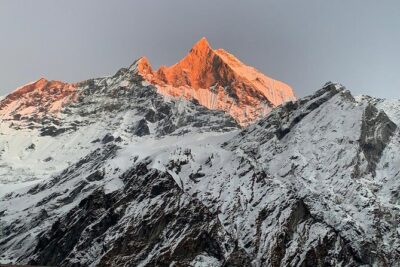
Day 4 is a classic Annapurna climb day. You start with a steep ascent for about two hours, then the trail eases into Magar villages along the way, including Ulleri (2070m) and Banthati. The payoff is big: you pass into view territory for peaks like Machhapuchhare, also called Fish Tail (6997m), Himchuli (6441m), and Annapurna South (7219m). These are the kinds of landmarks you start using mentally, not just admiring with awe.
One drawback to keep in mind is sheer trail character. Early stone work, steep sections, and village-to-village movement can feel like more than “just a warm-up,” especially if you fly in from sea level. Go steady, and don’t try to win the day.
Day 5: The Poon Hill sunrise run and why the early wakeup earns its keep
Day 5 includes an early morning hike to Poon Hill (3210m) to catch sunrise. This is a well-known moment on the Annapurna route, and the plan here is built around it. You’re aiming at a sunrise over multiple peaks, including Dhaulagiri (8167m), Annapurna I (8091m), Machhapuchhare, and other surrounding summits like Lamjung Himal (6931m) and Tukuche Peak (6920m).
This day is the reason many people book ABC. Sunrise from a viewpoint like Poon Hill gives you a high-altitude “systems check.” You get your bearings fast, you feel the elevation change in your breathing, and then you can settle into the rest of the trek with a clearer sense of what you’re chasing.
The consideration is simple: an early start means cold mornings. Even though tea house treks typically provide hot drinks and warm spaces, your body will still feel the start of the day. Pack your layers and keep your breathing calm.
More Annapurna Base Camp treks:
- Annapurna base camp trek 5 Days
★ 5.0 · 252 reviews - 14-Day Private Annapurna Base Camp Trek
★ 5.0 · 180 reviews - Annapurna Base Camp Trekking
★ 5.0 · 116 reviews - Annapurna Base Camp Trek
★ 5.0 · 111 reviews
Day 6 to 7: Ullery onward toward Chhomrong, forests, and a very practical Chhomrong rest day
By Day 6, you’re trekking from Tadapani to Chhomrong, around 5 to 6 hours across varied terrain, about 7 to 8 kilometers. This is one of the key transition stretches, from lush forests and village paths into a base-area village that feels like home for many people on this route.
Chhomrong is a popular village beneath the Annapurna range. It’s also known for a Gorkha connection and, importantly for your morale, it’s mentioned as a place where you can try pizza for dinner. That’s not why you do ABC, but it is why you might finish dinner with a grin and stop thinking about how sore your knees are.
Day 7 continues leaving Chhomrong. The trail descends via a stone staircase, then crosses rocky terrain where stinging nettles are mentioned as a warning. You reach three hotels at Sinuwa and a check post at 2350m, then descend through bamboo and rhododendron forests. After a muddy trail section, you reach Himalaya (2920m).
Two things to note here. First, Chhomrong gives you a big rest opportunity, and that matters because the next days push you toward higher country. Second, that netttle warning is real life on the trail. Long pants help, and you don’t want to reach camp thinking your skin got attacked by the local plants.
Day 8 to 9: Alpine views, the approach to 4170m, and reaching Annapurna Base Camp
Day 8 focuses on high-country scenery as you approach Base Camp. You’ll pass viewpoints for peaks including Hiunchuli (6441m), Annapurna South and Annapurna I (8091m), Gangapurna (7454m), and Machhapuchhare. The path continues through alpine forest and then you move closer to Annapurna Base Camp at 4170m.
This is the day where “the trek” becomes “the destination.” Even if you’re tired, the climb and the panorama shift your mindset. And because your guide is there, you have someone to help you interpret what you’re seeing, rather than just walking in fog and guessing.
Day 9 is built for the moment after arrival. After morning views from Annapurna Base Camp, you have breakfast then walk down to Bamboo, around 5 to 6 hours. Bamboo sits lower than Base Camp but still high enough to keep you in the hiking rhythm while letting your body recover from the highest effort.
A drawback for Day 8 and 9 is weather sensitivity. ABC sits at altitude and conditions can change. A well-run operator helps you respond with minimal stress, including the mention of travel rescue arrangements and an available first aid kit. Still, your role is to listen to your guide, hydrate, and take rest when offered.
Day 10: From Sinuwa to Chhomrong Khola, stone steps, and a hot spring reset
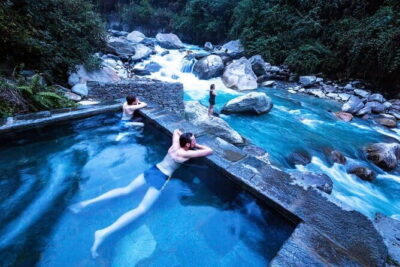
Day 10 is a long, mixed day that includes both trekking legs and a real reward. You begin with a gradual descent to Bamboo through rhododendron, oak, and bamboo forests. Then the trail steepens to Kuldi Ghar and levels until Sinuwa. From there you gradually descend to Chhomrong Khola and follow stone stair sections for about an hour to reach Chhomrong. The last part is steep down to Jhinudanda, then you walk down for about 20 minutes to the hot spring on the bank of the Modi Khola.
I love this structure because it gives you something practical: a warm reset for tired legs. Hot springs are not magic, but recovery tools are part of smart trekking. If you take the hot spring seriously for 20 to 30 minutes, your next day feels more manageable.
Day 11 to 12: Waterfalls, Birethanti, the river corridor, then cable car country and Kathmandu gateway
Day 11 starts with descent and scenery focus. You’ll descend while observing waterfalls, then the trail ascends gently crossing streams and terraces. After a short trek you reach Birethanti (1025m). The path then gently ascends to Nayapul through forest while following the Modi river.
This is the day that feels like your legs are finally paying attention to the ground again. The river corridor can also help you keep your pace steady, because it gives you an easy mental line to follow.
Day 12 is the transition back toward Kathmandu with an interesting stop. On the way you head up to Damauli, Dumre, Muglin, and Kurintar, where Nepal’s first cable car connects with the Manakamana Temple area. From Naubishe you climb up to Thankot, described as the gateway to the capital. In the evening, there’s a farewell dinner at an authentic Nepalese restaurant with a cultural performance.
That dinner and performance are a good close because they turn the trek into a complete story. You’re not just dropping into a hotel room after altitude. You get a final shared moment with your guide team.
Day 13: Airport transfer timing and a clean landing back in regular life
On Day 13, a representative takes you to the airport, about three hours before your scheduled flight. The point is simple: you are not rushing through traffic or last-minute check-in.
This final transfer wraps up the experience back at the meeting point, which is stated as returning to the airport meeting area. If you like knowing your timeline, this kind of buffer is one of the quiet advantages of a packaged trek.
Price, value, and what the $1,200 actually buys you
At $1,200 per person, this ABC trek package is not “cheap,” but it’s not just paying for walking scenery. You’re paying for the stuff that usually gets messy when you self-arrange: permits, organized tea house lodging, and meals during the trekking days. You also get guide leadership and porter support, plus private airport and land transfers, two nights in Kathmandu and two nights in Pokhara in 3-star hotels with breakfast.
Here’s the value angle I’d keep in mind. Trekking in Nepal is partly a travel problem, not just a hiking problem. When someone handles TIMS and ACAP permits, arranges tea house rooms, and includes all meals during the trek, you spend less time negotiating logistics and more time adjusting to altitude and weather.
What’s not included is also clear. Nepal visa fee, international airfare, travel and rescue insurance, personal expenses like phone calls, laundry, battery recharge, bottled or boiled water, shower costs, and tips for guide and porter. If you already have insurance and you budget for tips and personal spending, the overall value usually looks better than you might expect.
The guide and porter factor, safety, and why it affects your actual experience
This package includes an experienced, helpful and friendly guide and porters, with the mentioned ratio of 1 porter for 2 clients. That isn’t just comfort, it’s workload management. When you’re nearing Annapurna Base Camp at 4170m, any extra weight can turn into fatigue you feel for days.
One recurring theme in the names associated with this company includes guides such as Prakash Adhikari, Badri Kakri, and Bharat Simkada, plus porters like Surman and Perlad. You should not count on a specific individual, but it tells you the operator has worked with a consistent pool of staff that other hikers have described as attentive and supportive.
Safety is also practical here. There’s mention of arrangement of travel rescue and medical supplies (first aid kit available). On a route that can get busy and weather can shift, that kind of backup matters.
Who this Annapurna Base Camp trek suits best
This is for you if you want a moderate fitness level trek and you like the idea of a private group experience, not a big cattle-train trek. It’s also a good match if you want to avoid the permit and daily meal scramble, because the package handles TIMS, ACAP, tea house lodging, and meals during the trek.
It’s less ideal if you want total independence. Even though you go at your own pace within the trek structure, your days are scheduled around transfers and lodging arrangements, like any guided package.
Should you book this 13-day Annapurna Base Camp trek?
I’d book it if you want ABC’s highlights with the hard parts made easy: permits taken care of, meals included, tea house stays arranged, and solid logistics from Kathmandu to Pokhara and back. This is especially attractive if it’s your first big Himalayan trek or if you’re traveling with limited time and want fewer surprises.
Hold off if you’re expecting a walk in the park. Even with porter support and included meals, the route includes steep climbs, long hiking hours, and altitude days like Poon Hill and Base Camp approach. If you’re the type who needs maximum spontaneity, you might feel constrained by the structured land transfers and scheduled hotel nights.
If your goal is a well-run ABC journey that keeps you focused on views, acclimatization, and recovery, this package is a strong choice.
Latest additions near Kathmandu
- White Water River Rafting – 1 Day★ 4.3 · 3 reviews
- Traditional Momo Making Class★ 5.0 · 10 reviews
- Kathmandu to Pokhara Premium sofa bus ticket★ 4.0 · 17 reviews
- Ghorepani Poon Hill Trek★ 5.0 · 16 reviews
- Amazing 1 Day Trekking Experience in Kathmandu Nepal★ 5.0 · 24 reviews
- Ghorepani Poonhill Trek★ 5.0 · 5 reviews
- Walking tour of real Kathmandu through back streets.★ 5.0 · 3 reviews
- Wildlife Adventure in Chitwan Nepal★ 4.0 · 4 reviews
Annapurna Base Camp Treks, compared.
Kathmandu to Annapurna Base Camp (ABC) 5-Day Trek
Read our review →
Browse the lists this tour appears in