
Reviewed · UNESCO HERITAGE TOURS
UNESCO Five World Heritage Tour in Kathmandu
Seven UNESCO stops, one smooth day.
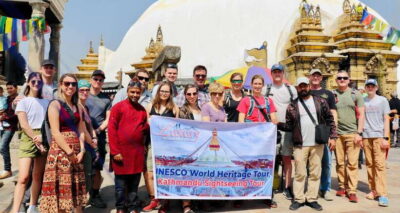
This private full-day Kathmandu Valley tour is built for people who want major UNESCO World Heritage sights without spending the day bargaining for rides. I like how the route covers Kathmandu and Patan Durbar Squares plus big spiritual anchors like Swayambhunath, Pashupatinath, and Boudhanath, with your guide filling in the meaning behind what you see. The best part for your sanity is that hotel transfers are handled within the Ring Road area, including Bouddha.
What really makes it work is the human side, your guide. Guides such as Shanti, Sarita, Tej, Shanthi, or Rabina are described as professional and service-minded, and the day is paced so you get context, not just photos. I also like that the sites show Kathmandu’s layered Buddhist and Hindu traditions side by side, so the valley feels like one living story instead of separate checkboxes.
One consideration: it is a long circuit, about 7 to 8 hours, and some stops are intentionally short, like 5 to 15 minutes in key courtyards and temple areas. Also, food and drinks are not included, so you will want to plan ahead or grab something before you start.
In This Review
- Key highlights that make this tour worth your time
- Why this Kathmandu UNESCO circuit works so well for first-timers
- Price and what you actually get for $130
- Pickup, timing, and how the day flows from stop to stop
- Swayambhunath: the two-faith stupa that anchors your whole day
- Amideva Buddha Park: a short break of big Buddha presence
- Kathmandu Durbar Square: royal courtyards and reconstruction reality
- Basantapur Tower and the Taleju cluster in Kathmandu
- Kumari Chowk and Kaal Bhairab: the sacred courtyard and Bhairav statue
- Patan Royal Palace and Patan Durbar Square: where Newar craft takes center stage
- Taleju Mandir, Patan Museum, and the Golden Temple trio in Patan
- Vishwanath and Bhimsen Temples: two quick stops that explain local belief
- Pashupatinath: Hindu temple complex scale you can feel
- Boudhanath Stupa: Buddhist worship in a huge dome setting
- The guide factor: why names like Shanti and Sarita matter
- Who this tour is best for, and who should skip it
- Practical tips to make the most of a packed day
- Should you book this UNESCO Kathmandu Valley day trip?
- FAQ
- What time does the tour start?
- How long is the tour?
- Where are hotel pickups and drop-offs included?
- Are entry fees included?
- Is food included?
- Is this tour private?
- Which major sites are visited?
- Can I cancel for a full refund?
- How far in advance is it commonly booked?
Key highlights that make this tour worth your time
- Ring Road hotel pickup and drop-off, including the Bouddha area, so you do not burn your day on logistics
- Entry fees included for the heritage sites, which saves time at ticket counters
- Private car with a professional guide, built for short-stay visitors who want a lot in one day
- Kathmandu Durbar Square and Patan Durbar Square, including the royal-courtyard atmosphere Newar craftsmen are famous for
- Big spiritual anchors in sequence (Swayambhunath, Pashupatinath, Boudhanath), so you experience both faiths in the same loop
- Guides named in the feedback, including Shanti, Sarita, Tej, Shanthi, and Rabina, known for clear explanations and good timing
Why this Kathmandu UNESCO circuit works so well for first-timers
If your time in Kathmandu is short, you can either do a few sites well, or you can see the major UNESCO highlights in one go. This tour is clearly in the second camp, but it is not rushed in a chaotic way. It is structured around a sensible route and guided commentary, so you understand what you are looking at while you are looking at it.
I like that the day includes both the royal, artistic side of the valley and the religious powerhouse sites. That means you are not only staring at monuments, you are also getting the cultural logic of why these places matter.
The pace makes sense for a full day, starting at 9:00 am and running about 7 to 8 hours total, with driving and buffer time between stops. Even the shorter stops are there for specific reasons, like a signature tower view, a temple doorway, or a courtyard tied to a living tradition.
More UNESCO Heritage Tours in Kathmandu:
- Private Kathmandu Sightseeing Tour | UNESCO World Heritage sites
★ 5.0 · 756 reviews - Kathmandu: 7 UNESCO Sites with Lunch
★ 4.8 · 744 reviews - Kathmandu: Full Day 7 UNESCO Tour with Lunch – Private/Group
★ 5.0 · 415 reviews
Price and what you actually get for $130
At $130 per person, this tour is not trying to be a budget backpacker move. But for many visitors, it can be excellent value because several costly hassles are handled for you.
You get private car transport, a professional guide, and entry fees for the heritage sites. If you try to piece this together on your own, you will spend time coordinating rides, and you will still need tickets for the UNESCO locations. In other words, you are paying for saved time and stress, not just for someone to drive you around.
You also get hotel pickup and drop-off within the Ring Road area, including Bouddha. That matters, because Kathmandu can be easier to navigate in theory than in real traffic time. And since the tour is private, you are not stuck waiting on strangers.
One small detail that can matter in cost planning: the experience notes group discounts. If you are traveling with friends and can keep the group together, it is worth asking how the discount is applied.
Pickup, timing, and how the day flows from stop to stop
The tour starts at 9:00 am. From there, you move through a sequence of sites that keeps the day coherent: start with Swayambhunath, then the Durbar Square areas in Kathmandu and Patan, then Pashupatinath, and finish with Boudhanath.
You will notice the stop lengths vary. Some are longer, like 1 hour at Swayambhunath, 1 hour at Kathmandu Durbar Square, 1 hour at Patan Royal Palace, and 1 hour at Pashupatinath. Others are quick hits, like 5 minutes for Kaal Bhairab or 10 minutes for Degu Taleju Temple and Golden Temple time at Patan. That mix is the whole point. You get the big context at major stops, and you still hit the must-not-miss details.
Also, there is no food included. In a day like this, that can be the biggest practical limiter. If you know you get hungry quickly, plan a meal before the start time or make a strategy for breaks near your route.
Swayambhunath: the two-faith stupa that anchors your whole day
Swayambhunath Stupa, often called a holy ground for both Buddhist and Hindu communities, is the opening act for a reason. Seeing it first helps you understand the valley’s spiritual overlap later, when you are standing in other temple precincts.
This stop is about 1 hour and includes admission. You also get the added bonus of a hill-top environment, meaning this is one of those places where you feel the landscape around you even if you do not stay for views forever. Your guide’s job here is to connect the symbols you see to the living traditions that still use the site today.
If you like religious architecture, this is a strong start. It sets the tone for a day where you keep noticing how the same place can reflect different beliefs.
More History Tours in Kathmandu:
- UNESCO Seven World Heritage Tour in Kathmandu
★ 5.0 · 253 reviews - Nepal Discovery Tour: Heritage Sites & Scenic Hill Easy Hike
★ 5.0 · 121 reviews - Kathmandu Private Sightseeing Tour | UNESCO World Heritage Sites
★ 5.0 · 109 reviews - Kathmandu World Heritage Tour
★ 5.0 · 74 reviews
Amideva Buddha Park: a short break of big Buddha presence
Right by the Swayambhunath hill area, you will stop at Amideva Buddha Park. This is a fast detour, about 15 minutes, but it is visually striking because the park includes three large statues of Shakyamuni Buddha.
Think of this as a palate cleanser. After a major stupa, you get a moment of calmer, statue-focused sightseeing. It also helps you slow down just enough to absorb what you saw at Swayambhunath before the day turns into courtyards, temples, and palace areas.
Kathmandu Durbar Square: royal courtyards and reconstruction reality
Next comes Kathmandu Durbar Square, around 1 hour with admission included. This is described as one of Kathmandu Valley’s royal squares, packed with historic and religious structures.
One honest detail here is that many areas are being reconstructed. That means your experience might look a little different depending on what stage of repair is happening at the moment you visit. Instead of treating that as a downside, treat it as a reminder that heritage is not frozen in time. It is maintained, rebuilt, and kept alive.
Durbar Square is also where the day starts to feel more Newar in style, with architecture and temple detailing you can really appreciate up close.
Basantapur Tower and the Taleju cluster in Kathmandu
Within the Durbar Square area, you will have time for a few targeted highlights.
First is Basantapur Tower for about 30 minutes. It is singled out as one of the attractive places to visit in the square, and it makes sense because towers in these complexes give you a stronger sense of how the space was designed and used.
Then you move into the Taleju zone, with Degu Taleju Temple for about 10 minutes. Taleju is described as having been built in 1564, which gives you a nice historical anchor for what you are looking at.
Kumari Chowk and Kaal Bhairab: the sacred courtyard and Bhairav statue
Two small stops pack big cultural signals.
Kumari Chowk is about 10 minutes. It is a sacred courtyard inside a red-brick, three-level building that was once home to Kumari, the living goddess chosen until she reaches puberty. Even if you do not spend long here, this stop gives you the valley’s tradition of sacred living roles, not just temples and stones.
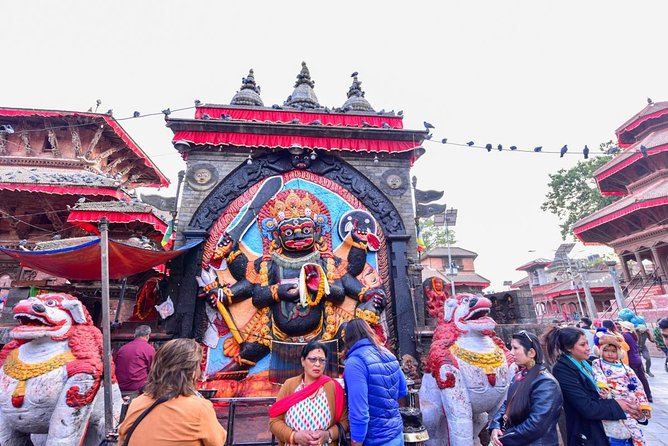
Then, for about 5 minutes, you visit Kaal Bhairab, described as a statue of Bhairav within Kathmandu Durbar Square. Short, yes. But it is the kind of stop that helps you feel how local worship can be both formal and intensely personal, expressed through a single powerful icon.
Patan Royal Palace and Patan Durbar Square: where Newar craft takes center stage
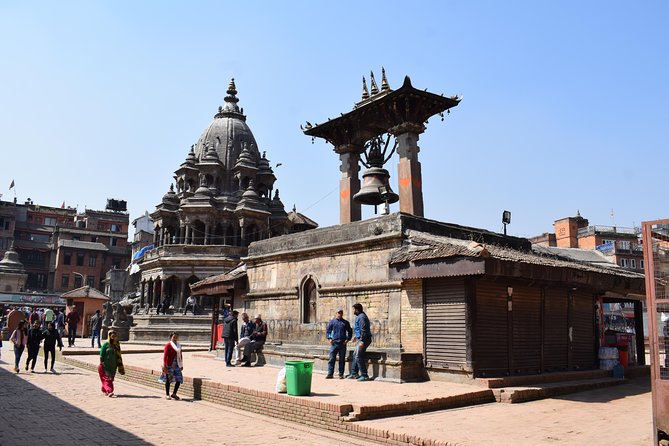
After Kathmandu, the tour shifts to Patan with a longer stop at Patan Royal Palace for about 1 hour. This area is described as being around Durbar Square in Lalitpur and as one of the oldest royal palace areas of Patan. You are in the right place for seeing how royal spaces link to temples, museum culture, and the craft traditions that made the valley famous.
Then you move to Patan Durbar Square for about 45 minutes. This is described as the adobe for Newari architecture, with many temples and artistic creations established by the Newar community. If you care about design, carving, and how buildings carry meaning, this is usually the part of the day where people stop thinking in terms of landmarks and start thinking in terms of style and craft.
Taleju Mandir, Patan Museum, and the Golden Temple trio in Patan
In Patan, you get a compact sequence of sites that balance worship, art, and preservation.
First is Taleju Mandir Temple for about 15 minutes, rebuilt after a fire in 1676 by Srinivasa Malla. That rebuilding detail matters because it shows you heritage is shaped by history, not just by original creation.
Then comes Patan Museum for about 15 minutes. It is described as worth visiting, with old statues and carved windows plus wooden pillars. Even if you prefer outdoor sightseeing, a museum stop in a day like this can help you understand what you just saw on the streets by giving objects a clearer frame.
Finally, you reach the Golden Temple, also called Hiranya Varna Mahavihar. This is about 10 minutes, described as a 12th-century temple with bronze statues and golden and silver decorations. The temple is pagoda-style, and it includes a golden image of Lord Buddha.
This is a quick stop, but it is a high-impact one. You get a feeling for how brightness and religious symbolism blend in Patan’s temple tradition.
Vishwanath and Bhimsen Temples: two quick stops that explain local belief
Next, the tour includes two shorter temple visits.
Vishwanath Mandir Temple takes about 5 minutes, described as dedicated to God Shiva and built during the reign of Siddhi Narsingh Malla. Even at just a few minutes, the stop gives you the Shiva-centered thread that connects back to Pashupatinath later in the day.
Then Bhimsen Temple for about 15 minutes. It was built in 1680 by Srinivasa Malla and is worshiped as a god of business and trade by the Newar community. This one is easy to overlook if you only care about the biggest monuments. But it adds a practical dimension to religion, showing how faith can be tied to work and daily life.
Pashupatinath: Hindu temple complex scale you can feel
When the tour reaches Pashupatinath Temple, it becomes the most intense Hindu anchor of the day. It is described as a Hindu complex with over 500 shrines and temples, and it is described as the main temple for all Shiva devotees.
This stop is about 1 hour and includes admission. In a circuit like this, that time is important because a complex of that scale is not something you can fully process in a quick walk-by. Your guide’s commentary helps you understand what areas represent, how worship is organized, and why people treat it as a must-see for Shiva-centered devotion.
Boudhanath Stupa: Buddhist worship in a huge dome setting
To close the day, you visit Boudhanath Stupa for about 1 hour, with admission included. The stupa is described as a Buddhist symbol in Nepal, with a large dome-shaped structure about 36 meters high. It is also surrounded by prayer wheels and picture carvings of Buddha.
This is a different atmosphere from Pashupatinath. Instead of a sprawling Hindu complex feel, you get a monument-centered Buddhist worship rhythm. It is also a good finishing point because you have already seen enough temple variety that Boudhanath can land as a clear, cohesive finale.
The guide factor: why names like Shanti and Sarita matter
A lot of tours say they have a guide. This one specifically highlights professional guiding, and the names in the feedback give you an idea of the style you can expect.
Guides such as Shanti, Sarita, Tej, Shanthi, and Rabina are repeatedly linked with traits like being polite, attentive, service-minded, and good at answering questions. Timing also shows up as a theme, with people describing the flow as well organized and stress free.
What that means for you: you are not just visiting sites, you are getting the “why” while you stand in front of the “what.” That is the difference between seeing monuments and actually understanding the valley’s logic.
Who this tour is best for, and who should skip it
This tour is a great fit if you want a full-day UNESCO highlight circuit, and you do not want to solve Kathmandu transportation and ticket problems yourself. It is especially good for first-timers who care about architecture and culture, and for people who want to see how Buddhist and Hindu traditions interlock across the Kathmandu Valley.
You might not love it if you are the type who needs long, slow time at every stop. The short durations at some signature locations mean you are sampling, not camping out. If you want hours inside each temple courtyard, consider a slower, single-area approach instead.
Practical tips to make the most of a packed day
Because this itinerary is heavy on sacred spaces, keep your expectations aligned with the format. You should plan to walk through temple precincts and courtyards, and you should expect to pause, observe, and then move on fairly quickly at certain points.
Since food and drinks are not included, treat that as part of your planning, not an afterthought. If you tend to get cranky when hungry, plan a breakfast that actually sticks with you, then decide how you will handle lunch on your own.
Also note the tour is private, meaning your schedule is your group’s schedule. That is a plus if you like flexibility, but it also means your guide will be keeping the day running based on the overall route plan.
Should you book this UNESCO Kathmandu Valley day trip?
I think you should book it if you want the major UNESCO World Heritage sites in the Kathmandu Valley in one organized day, with entry fees included and Ring Road pickup and drop-off done for you. The best value here is saved time and guided context, especially when you are bouncing between Kathmandu and Patan plus the major spiritual anchors.
I would skip it if your priority is lingering, photographing for long stretches, or deep study at a single site. This tour is designed for short-stay structure, not slow immersion.
If your goal is to leave Kathmandu with a strong first picture of the valley’s religious and architectural story, this one-day circuit is a solid way to get there.
FAQ
What time does the tour start?
The start time is 9:00 am.
How long is the tour?
It runs about 7 to 8 hours.
Where are hotel pickups and drop-offs included?
Pickup and drop-off are included inside the Ring Road area, including the Bouddha area.
Are entry fees included?
Yes. The entry fees of all heritage sites are included.
Is food included?
No. Food and drinks are not included.
Is this tour private?
Yes. It is private, and only your group will participate.
Which major sites are visited?
You can expect stops such as Kathmandu Durbar Square, Patan Durbar Square, Swayambhunath, Boudhanath, and Pashupatinath, along with additional sites in the same circuit.
Can I cancel for a full refund?
Yes. Free cancellation is available, with a full refund if you cancel up to 24 hours before the experience starts.
How far in advance is it commonly booked?
On average, it is booked about 55 days in advance.
Latest additions near Kathmandu
- White Water River Rafting – 1 Day★ 4.3 · 3 reviews
- Traditional Momo Making Class★ 5.0 · 10 reviews
- Kathmandu to Pokhara Premium sofa bus ticket★ 4.0 · 17 reviews
- Ghorepani Poon Hill Trek★ 5.0 · 16 reviews
- Amazing 1 Day Trekking Experience in Kathmandu Nepal★ 5.0 · 24 reviews
- Ghorepani Poonhill Trek★ 5.0 · 5 reviews
- Walking tour of real Kathmandu through back streets.★ 5.0 · 3 reviews
- Wildlife Adventure in Chitwan Nepal★ 4.0 · 4 reviews
UNESCO Heritage Tours, compared.
Private Kathmandu Sightseeing Tour | UNESCO World Heritage sites
Read our review →
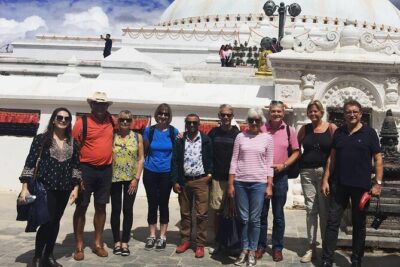
Full Day 7 UNESCO Tour with Lunch – Private/Group
Read our review →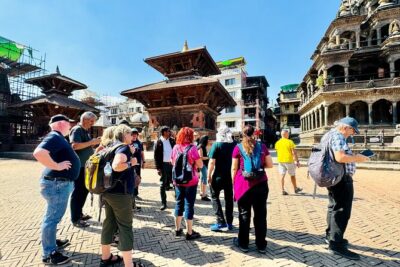
Full Day Top 4 UNESCO Tour with Lunch – Private/Group
Read our review →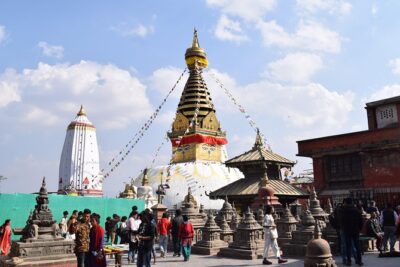
Kathmandu Private Sightseeing Tour | UNESCO World Heritage Sites
Read our review →Browse the lists this tour appears in